*Nicad's Revisited*
By Mr. Poyz
Before we start, I'd like to say that this isn't my brain-child. Most of it is the work of a retired electronics teacher, HAM, general wizard and comm. sgt. who shall remain unnamed. Neither of us has any commercial interest in this, but, well... there is a word for people who profit from someone else's inventions...
Also, it is important to remember that while the above has been tested for several years at battalion level in a nat. guard unit, you must experiment yourself and find out what works for you. If I can't take credit for your successes, I won't accept liability for your screwups.
AA NiCad discharger, and ramblings on NiCad maintenance
Anyone who has tried to maintain rechargable batteries in any volume, for any length of time knows what a PITA they can be. Several years back I used to be involved in comm. equipment maintenance for the Swedish home- guard, which meant that I had a small mountain (well, that's what it felt like at times) of these little buggers to look after.
Anyway, The literature usually suggests repeated charging and discharging as the medicine for sluggish NiCads, and that will certainly do the trick, but there is a small problem.
A normal, healthy NiCad is considered full at 1.2v, and empty at a bit under 1.0v, and it shouldn't be discharged much further. Now, think about what happens if you have, say a regular 10 cell CB radio with one cell much weaker than the rest of them:
Your team is moving out, everyone puts a fresh NiCad pack into their radios and turns them on. Someone (depending on SOP) runs a radio check. Everything is fine. After an hour or so, for whatever reason, you observe something and need to use the radio, and find that it's dead.
Depending on how well prepared you are, you either curse and swap for a fresh NiCad pack, curse and swap for alkalines or curse and curse some more.
Sounds familiar?
What happens is that the bad cell runs completely dry, and starts getting charged in reverse by it's still healthy companions. At the same time, the total voltage drops from 12 at most to 10.8 minus losses to the resistance of the empty NiCad at best, and the radio starts to behave as if the pack was almost depleted.
We now have three bad conditions:
* The radio is dead.
* Nine of the cells will be getting a full recharge before they're empty, which isn't good, but at least if you're using a regular, non-rapid charger (which you should, for best service life) it's tolerable.
* The tenth cell is getting reverse-charged every time the radio is used, and unless noted it will lose it's ability to take charge in any direction before long.
To all those that have experienced freshly charged battery packs that just dies after anything from 20 minutes to 1 hour, now you know why.
What we need here is a way to discharge every NiCad completely, without going too far, and without risking reverse-charge. We also need a way to weed out the cells that are lost beyond reconditioning, but more on that in a moment.
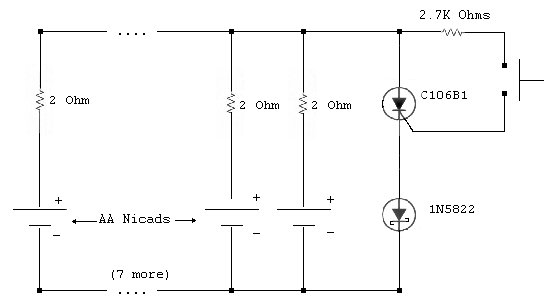
Parts:
10 Resistor 2 Ohm.
10 Single AA battery holders.
1 Resistor 2.7K Ohm.
1 Switch, momentary closing.
1 Shottky diode 1N5822.
1 Thyristor C106B1.
The usual assorted stuff.
Theory:
=======
The NiCads are connected in parallel, each one with a small resistor in series (2 Ohm) to limit current a bit. Note that even if each resistor don't get too much current, The combined current is too large to just ignore. Plan for currents in the 1 Ampere-range, and err on the safe side.
The controlling device/dummy load is a thyristor, that is "lit" through a momentary closing switch and a 2,7kOhm resistor connected to the plus side of the battery bank. This Thyristor will run a bit warm initially, and it's prudent to bolt it to a piece of metal for cooling. If you manage to get exactly the right thyristor, that's all. In tests mine didn't shut down until the batteries were a bit too far drained, so I added the diode to up the voltage a bit. If you're scrounging for equivalent parts, you want a thyristor that needs a fairly low current to stay lit, and that has a voltage drop of about 1 volt at these low currents. The diode was chosen from the shottky-family, as these happens to have a very small forward voltage drop at low currents.
As a sidenote, this device is not suitable for D-cells, as they generate too high currents.
Operation:
==========
1. Have dinner.
2. Load the device with as many batteries as you like. It doesn't need to be full to work, but ALL BATTERIES GOES IN THE SAME DIRECTION. THIS SHOULD BE CLEARLY MARKED ON THE DEVICE. Reversing polarity of one or more cells is BAD. Anything from damaged cells to TSBS (Thin Streak of Blue Smoke (tm)) could result.
3. Press the button.
4. The following morning, press the button once more, for good measure.
5. After lunch, remove the empty cells. Done.
Recharge and repeat as necessary. This isn't the scientific way to do it, but remember; "if it's stupid, and works, it ain't stupid".
The device will run it's cycle and then shut down automatically, so there is no harm in waiting a bit longer, but good logistics dictate that this should be done as fast as convenient. If you need higher throughput, the device can be extended to hold more cells, the limiting factor would be the initial current over the thyristor. Or, several devices could be deployed. They aren't expensive to construct.
Any suggestions as to how to add an indicator to this device without adding a separate powered supply (that was one of the design criteria, and in my opinion it's worth the lack in functionality)
Spotting a bad cell
===================
For this stunt you'll need an old beaten up analog instrument that can measure a rather high current. 10A is probably good, if it's an analog device, More for a digital, as they often has less internal resistance. Mine goes to 5A, and I guesstimate by judging how fast the needle hits the top of the scale. Those who knows say that this is a stupid trick, but I don't use this instrument for much else, and it was beaten-up when I got it.
First run the NiCads through at least two complete charge- discharge cycles, to ensure that they're fully charged, and to cure light problems.
After that, you have to try and judge capacity of the individual cells. The only sure way to do that is to measure short circuit current of a freshly recharged cell. You do this by touching the probes of the instrument to the cell and then immediately withdrawing them. One second is about par, and if you can do it quicker, you should. The dud is the one with much lower reading than the rest. If you have a lot of cells it may be a good idea to try and match cells with about similar readings in one pack. As my equipment and method for doing this is a bit mickey-mouse, I concentrate on weeding out the real bad apples. If I come across a lot of cells that are half-bad, they may get assembled in one pack that's assigned light duty, as they will be ruined fairly quickly when mixed with good ones. If they're put among peers, and treated well, they will probably improve with time. If you want to, you can run the matched pack through several charge-discharge cycles, which will improve their capacity.
Maintaining readiness with NiCads
=================================
One frustrating problem with NiCads is that they only last about a month or so, if left charged at room temp. If you want to be able to deploy in a hurry, this is not good news.
Tests have showed, however, that the same NiCads, when packed to avoid moisture, and stored in a freezer will hold charge for six months or more. A local airforce lt. claims that if a fridge that goes down to -28 celsius can be found, the time is extended to one full year, but I haven't tried this. The only thing to remember is to let them thaw before using them.
What we did, was to charge and freeze all battery packs. Those that got used, was de-charged with the device above, then recharged and returned to the freezer. Packs that weren't used for six months, were thawed, discharged, recharged and frozen.
This procedure cuts down the number of alkalines one has to keep at hand for "right now" emergencies, as it shortens the time needed to get the normal field recharge operation up to speed.
Good luck.
Mr. Poyz
Return to The Alpha Group Web Page
 Send Warlord E-mail.
Address: 
All materials at this site not otherwise credited are Copyright © 1996, 1997, 1998, 1999, 2000 Trip Williams. All rights reserved. May be reproduced for personal use only. Use of any material contained herein is subject to stated terms or written permission.