*A Scanning Primer*
Getting useful information on local emergencies
By Tailgunner
Why use a scanner, why even bother? The most important reason to monitor the radio waves is to gain knowledge and intelligence. Knowledge is to gain information on conditions of roads, weather, areas of unrest to avoid, etc. Intelligence is mostly the same things, it is using the information gained in deciding on your course of action or what you need to prepare for. Every day and night, you can overhear on a scanner, police cars, fire engines, ambulances, airplanes, armored cars, trains, taxis, and buses. You can monitor the local police and fire departments to hear about events "as they happen," before the news reporters hear about them. You can hear about hostage dramas, bank robberies, car crashes, chemical spills, neighbor and domestic disputes, dangerous animal sightings, are all available. To be able to do that after only listening to radio activity for a few minutes can be difficult if you have not learned the different codes and procedures for police, fire departments, aircraft and marine operations. Possible targets to start looking for information would include police, fire dispatch, emergency reaction elements, military offices (like the base commander's frequency, or the MP's), aircraft and tower communications, marine operations (port etc), and of course the weather frequencies for weather alerts.
Affordable scanners are marketed by Radio Shack and Uniden (maker of Bearcat, Regency, and Cobra brands) who offer a wide choice of scanners. Radio Shack scanners are actually manufactured by both GRE (General Research Electronics) and by Uniden. Programmable (synthesized) units have replaced crystal controlled models as they don't require crystals and usually have a keypad that permits you to store frequencies into channels. Scanners can be divided into types such as Handheld, Mobile and Base units.
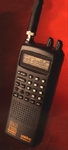
Handheld Scanners:
The handheld units are in my opinion the most versatile, in that they can be used in a house, mounted in a vehicle (perhaps using another antenna for increased intercept capability), or put in a pack or your web gear to keep abreast of available information and intell. In my mind the most versatile are the battery powered scanners. You can use rechargeable batteries (with a solar recharger), or use regular batteries, or even plug in a power adapter to the house AC circuit to supply power. The units with rechargeable battery packs are limited by your ability to recharge the power pack if house AC is unavailable. A problem with the handheld scanners is the size of the display, the relative quality of the speakers and antennas, they will just not perform as well as a quality desktop. However, within their limitations they are the best balanced option. Especially when severe weather knocks out the power in your home, there's nothing like having a battery operated scanner to monitor the power utility and police frequencies! All scanners come with a built in antenna, permitting reception up to about 20 miles or so. Portable scanners are supplied with the rubber duckie antenna. Some examples are the Bearcat BC245XLT (300 channel Trunk Tracker), BC60XLT-1 (30 channel), Sportcat SC200 (200 channels), etc.
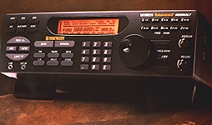
This includes those models which are designed to mount in vehicles, powered from the vehicle's 12V power supply and generally need an external scanner antenna. They are usually able to acquire signals farther away than handhelds, and generally have fair speakers and the ability to attach an external speaker. Some states do not permit scanners in vehicles and a mounted mobile scanner would cause problems. Where as a handheld could be turned off and put under the seat or in a case. Some examples are the Bearcat BC895XLT (base/mobile Trunk tracker)
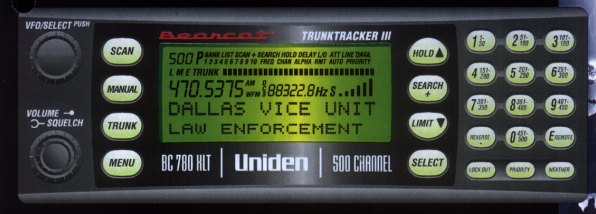
The desktop scanners I have seen usually have nice display screens and small attached antennas. They have the option of using a larger more efficient antenna, and a better quality external speaker. They are usually plugged into the house AC circuit and do not normally have battery backup for when the power is out. Some are capable of being also mounted in a vehicle where a 12V power supply is available. I have a very old Bearcat BC170 still working fine on its limited 16 channels, in the garage, but then that covers the local police, fire, air emergency and air-to-air frequencies. An example is the Uniden/Bearcat BC278CLT (100 channels), BC780XLT or my older BC170 (but it has a very limited capability).
Outdoor antennas can extend reliable reception to 50 miles or more, depending on terrain. If you do use an outdoor antenna, be sure to disconnect and ground it during storms and when not in use to avoid a lightning hazard. Discone and ground plane type antennas can be more prone to cause scanner damage due to static charge buildup because they are not at "DC ground."
If your antenna installation requires more than 50 feet of antenna cable, use RG213/U or high quality RG8/U coaxial cable. If you must use a small diameter cable for long runs, use RG6/U. Avoid RG58/U (7/32" OD) due to its losses at high frequencies. RG8/X (1/4" OD) is suitable for short patch cords.
No matter which model you get make sure your first scanner has a "search" feature, which allows it to search all the specific frequencies between two frequency limits of your choosing. And get a model which covers most of the bands from about 45mhz to 900mhz. I have three, 2 handheld scanners, and one desktop. Some excellent buys can be found at garage sales or ham fests, but the buyer beware, your area may have gone to Trunk Tracking systems and that excellent buy may not be able to get the signals you want.
With all the choices and options, you might ask yourself the next question, "how many channels do I need?" Again a good question, in our area 30-50 channels is plenty. However, around some LARGE metropolitan areas 100 to 300 may actually be useful. First look at where you will be using your unit and then count the frequencies you want to listen to and then double it. That should be your least number of channels for your first unit. Also look into whether you need to get a trunk tracker model or not. You can still get the info out of trunk tracking systems with a "standard" scanner capable of the 800mhz frequency spectrum where the trunk trackers operate, but it is a lot of work and can also be very frustrating.
To answer the previous question you should ask "Where do I get the frequencies?" A good question, they are supposed to be "Publicly" available, after all they work for us and as such we should be able to get information on who uses frequencies in our area from the FCC. Though it is not as easy as it sounds much is known. There is a magazine called "Monitoring Times" that helps greatly, you can even find advertised in it a CD-ROM of all the frequencies used in different regions. You can also get information on used frequencies from Internet sites that include:
http://www.bearcat1.com/free.htm
http://www.ungo.net/info-center/crime/crime024.htm
http://www.perconcorp.com/datafinder/
http://www.grove-ent.com/hmpgmt.html
http://www.netnerd-inc.com/joe/
http://www.oz.net/~gmcavoy/sw_frqsmap.html
http://www.wolfenet.com/~daydream/html/wwwboard/wwwboard.html
http://www.dmoz.org/Recreation/Amateur_Radio/Scanners/Regional/
http://www.execpc.com/~pwkfd/scanlist.html
Once you buy your scanner you should find a frequency insert packed in most scanner boxes that gives you a "few starter frequencies". Uniden has published several regional directories using the "Betty Bearcat" title, if you bought a Bearcat, there is a card in the box to order one.
You can also use the search capability built into most scanners to find other frequencies. When you are searching for new stations using the search capability you are faced with a difficult task of identifying your new target user. Although FCC rules require radio systems to identify their operations with their assigned call letters either automatically or verbally, most ignore the regulation. This often makes it difficult to know who is transmitting. Moreover, many radios are now being placed in service illegally, without first obtaining the required FCC license. However, if you practice and "tune" your ear to the procedures being used you can identify most. Find others in your area that are also "searching" because you can share with each other what you have found and they can help in identification and other frequencies. There is a challenge in deriving new frequency information on your own. Sometimes it requires several days of listening, taping, and compiling fragments of information. Other times, the frequency information is there for the taking - without hassle.
You can approach this in two ways:
1. Listen first: Monitor a frequency or frequencies, and try to determine who's transmitting and what purpose the channel serves. Once you identify the user, log the information.
2. Social engineering first: Take advantage of opportunities, such as examining the frequency label on a guard's radio, or reading the FCC license hanging on the "radio room" wall, to compile frequency lists, then monitor the listed frequencies to confirm that they are really in use.
Most listeners use a combination of both approaches. In many stations the actual FCC radio license, complete with frequency assignments, can be found hanging on the walls of places like the mall security office or company guard shack. If you can hold the radio you can examine the labels frequency information is usually engraved on labels on the back of many walkie-talkies, or inside the battery compartment. It's not uncommon to find labels embossed with frequencies or call letters glued to the front of base stations in many places. Perhaps getting a job as a part-time janitor would help find those you just don't have time to search for electronically. Or you can make friends with the cleaning crew and ask them to look. You can make your own opportunities for eyeing the equipment or take advantage of "open house" events. If information is displayed publicly, then a reasonable person could assume it's not a government secret.
If you don't know the exact frequency, but have a general idea of the range (e.g. 150 - 152 MHz), use your scanner's "search" mode. Most programmable scanners afford the ability to search between two frequency limits set by the user. A few models have the ability to automatically store active frequencies found during an unattended search operation. This is where it is important to read the manual and use the radio for a while and then read the manual again to see what you have missed the first time.
A short note on trunk tracking. Without going into all of the reasons for using a trunked system, trunking allows a city to more efficiently utilize a few frequencies that are shared by users thorough-out the city. Trunked systems, in layman's terms, frequency hop. A conversation between two deputy fire chiefs may occur on one frequency and then suddenly, during a pause in the transmission, the conversation will jump to an entirely different radio frequency. In the meantime, two sewer workers, in the same city or county as the fire chiefs, may suddenly occupy the first frequency. Thus, it becomes almost impossible to follow a complete train of thought. Trunked systems are generally in the 800mhz spectrum and many of the higher quality radios now have trunk tracking capability. First look to see if the systems in your area are Trunked, then purchase accordingly.
After you play with your scanner for a while you will find scrambled transmissions: Many federal law enforcement agencies (FBI, Secret Service, etc) and some local police agencies employ digital voice scrambling, which sounds like white noise and is annoying to hear. Unfortunately I am not aware of any easy method to decrypt these signals. However, many of these agencies use the simplex clear mode when they are not involved in sensitive operations, so when they do go to scramble mode you know that something is up.
As an end note I found some information on the internet about government frequencies that could be useable to someone out there but I haven't seen the book or CD: A readily available source of sensitive US government frequencies is Tom Kneitel's Top Secret Registry of US Government Radio Frequencies. Published by CRB Research, the 8th edition is available from Grove Enterprises for about $22. Kneitel's book contains frequency listings for NASA, military, FBI, Secret Service, DEA, IRS, Border Patrol, arsenals, ammunition plants, missile sites, and others in the 25 to 470 MHz range.
Grove website: http://www.grove-ent.com/
The FCC has an agreement with PerCon (tel. 716-386-6015), a private company, to sell FCC license information to the public on CDROMs. You can buy the full license information for a multi state region or a less detailed license database covering the the entire USA on CDROM. The PerCon Spectrum CDROM sells for around $30 and contains a handful of fields for every FCC license in the US.
Tailgunner
 Send Warlord E-mail.
  All materials at this site not otherwise credited are Copyright © 1996, 1997, 1998, 1999, 2000 Trip Williams. All rights reserved. May be reproduced for
personal use only. Use of any material contained herein is subject to stated terms or written permission.
All materials at this site not otherwise credited are Copyright © 1996, 1997, 1998, 1999, 2000 Trip Williams. All rights reserved. May be reproduced for
personal use only. Use of any material contained herein is subject to stated terms or written permission.