*Paintball Basics (Part 1)*
Introduction
Over the past 10 years paintball has evolved from a very "primitive" sport to a multi-million dollar industry with many players through the United States as well as the world. One of the most intimidating tasks for a beginner is the selection of proper markers (the gun "dang liberals"), safety equipment and the plethora of other accessories as well as tactics. Many newbies try to purchase the most expensive equipment and begin playing against veterans at local fields and end up becoming disenchanted with the sport before they can ever even really begin. I have heard numerous tails of people spending 1000’s of dollars on Top Line guns only to return them and claim they are defective because they kept getting hit so much. This will be a 3 part series of articles that will outline: Beginning and Advanced Paintball Gear (Article 1), Beginning Tactics and Games (Article 2) and Advanced Tactics (Article 3). I hope this series will help ease the fear for a beginner and open their eyes to the sport and also I hope to help out some veterans
Part 1: Gear
The Mask
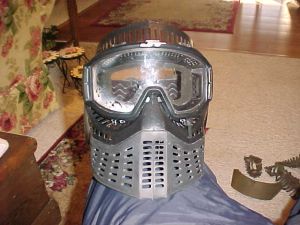
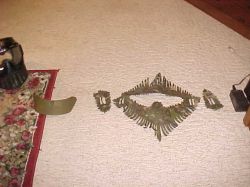
Before you even ask "Solidsnake, which paintball gun should I buy?", you need to ask "Solidsnake, which MASK should I buy?". The single most important piece of gear you can have is your mask. It protects your second, third and fourth, most important pieces of equipment (your eyes, ears and brain). I prefer to use JT masks because of their reputation. JT has many mask lines including the X-Fire (shown Below), the Proteus, Nvader, etc. etc. Be sure and check your mask when you buy it for visible signs of wear (especially if you buy a used one) as well as cracks, breaks, etc. NEVER use a broken mask. Many players add a Visor (to keep the sun out of their eyes and goggle flauge (like a ghillie suit for your mask) (Both Shown Below). I consider these advanced pieces of equipment and while yes I do use a visor, I opt to not use the goggle flauge because it has never really given me any advantages (most masks are black anyways). Another important piece of equipment is the lens for your mask. Many of the older len’s are single paned which cause A LOT of fog inside the lens, most of the new len’s now are double paned which helps to decrease fog and if you plan to buy a mask make sure its double paned. I have been shot numerous times because I could nto see out of a mask and this helps to eliminate the stupidity of taking off your mask during play to clean it. Also JT has introduced a 9v fan, which sits on top of the mask and draws out stale, hot air, which can also help to reduce fog (these tend to work VERY effectively but can make a lot of noise). Most lenses are clear but JT now offers a complete line of colors and even chrome lens. I carry a clear lens for nighttime use and a silver chrome lens for daytime use (this helps to cut down on sun blindness dramatically. The last piece of equipment for the mask is a good mask bag. Your masks will do you little good if you cant see out of it because of scratches on the lens. Most gear companies now sell felt lined mask bags, which can transport your mask WITHOUT scratching it. PS if you will notice I have not quoted any prices for Masks or the accessories, this is one area that I will advise ANY player to not skimp on. All the equipment that I listed is VERY beneficial and if you can afford it I would purchase them.
The Ball Hauling Gear
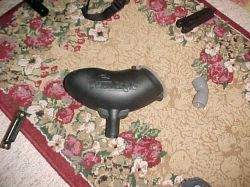
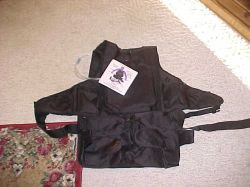
All right now that we have your face covered lets talk about how to hold your ammo. A gun will do you no good if you can’t hold any ammo for it. First we have the standard hopper (same as a magazine) for your gun. Its connected to your gun via an elbow (almost like the magazine well) and it sits vertically on top of your gun. It has two openings, a smaller one (see picture below) that lets the balls slide through one at a time into the gun and a larger opening for pouring many balls in at a time. NEVER pour balls into the hopper without having it connected to the gun. You will lose balls EVERYWHERE (trust me I have done it numerous times). Most hoppers have a spring loaded lid that will pop open just like a pringles can and will swing open and hold itself until you push it closed. This is useful for one-handed operations. The elbow allows your hopper to sit straight up and allows the paintballs to feed without problem. Some hoppers now have a revolving fan inside which will agitate the balls and solve jamming problems. These are very useful if you are shooting fully automatic because most guns will shoot a lot faster than most hoppers can load. There are also camouflage covers for your hopper, which can help to break up its silhouette because honestly this is the first part of someone’s marker you will probably see. Most hoppers come in 100 or 200 round sizes but some can even be found 75 and 50 round sizes with the largest being 300 rounds. Next we have the pack, which holds your spare balls and tubes, as well as your spare gear. Packs come in sizes 2+1 (it will hold two tubes and one CO2 Tank) , 4+1, 6+1, and even 8+1. The amount of tubes you wish to carry depends on your personal preference, how much you shoot per game, and your team position. Back players will need more paintballs which means MORE tubes, while an assaulter will need less paintballs because they shoot less and need more speed. Most packs will mount an equal number of tube holders on each side with a CO2 tank holder in the middle and will allow you to attach your own set of straps to your pack. Tubes come in a variety of sizes and colors. 140, 120, 100 and even 75 round tubes are common on the market. I prefer to carry a 6+1 Cobra Pack (Picture below). Its exactly like a LBV Setup and it allows me to carry 6 100 round tubes, a 20 oz CO2, my hydration bladder as well as ANY spare gear I would need (squeegees, o-rings, radio, etc.). These packs are useful but not necessary.
Gun Power
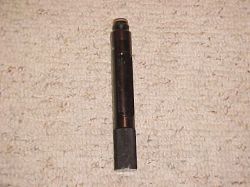
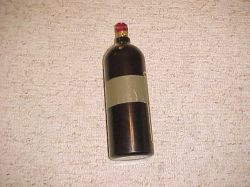
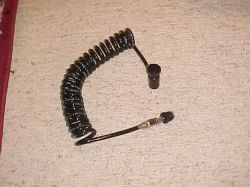
Nope your still not ready to buy a gun yet. I mean if you have a gun but no way to power it what good is it doing you? There are two main sources for powering your gun. CO2 and Nitrogen. The cheapest is definitely CO2 but you lose a lot of power with CO2 while Nitro is extremely expensive but for the tournament player the added range and accuracy can be very beneficial. I don’t use nitro so I will not go into great detail about it. CO2 tanks come in two different kinds. First are the 12 gram CO2 power pellets. Many of use have seen the Silver packs used to power many airguns. For paintball these are very useless and you can only get about 30 shots out of them. However, for a back up supply they can keep you in a game if you run out of air. To use them you will need an adapter (picture below) and power pack. You must change them each time you run out of air. To combat this problem, companies came up with CO2 Constant air tanks, which are huge tanks which will hold varying amounts of air. I use 2 20oz (pictured below)tanks which will give me about 1000 shots a piece. They also come in 7, 9, 12, 16, 18, 24, and 32 oz sizes. These screw into either the back or the bottom of a gun and if screwed into the back can be used as a butt to use like a rifle or as a forward grip to use like a sub machine gun. Now they even have slide on butt plates which look just like gun stocks. One drawback is that these make the marker VERY heavy and cumbersome. To combat this, a REMOTE (pictured below) was created which is a long tube that connects the gun to the CO2 tank and will allow you to sit the tank against your back removing the weight and allowing you to use the gun more effectively. However, now there has been created a t stock which screws into the gun and allows the air to run through the stock to the remote and will allow you to butt it against your shoulder like a rifle. The threads of tanks can become damaged if dropped so I recommend buying some thread savers (the red piece on top of my tank)which will protect the threads if dropped.
PS always oil the threads of your gun before screwing in your tanks.
Misc. Protective Gear
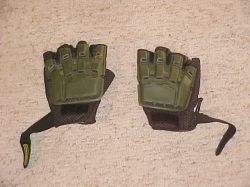
Other than the face mask there are not many other necessary items to protect but there are a lot of items for sale including, padded vests, neck protectors and even shin and knee guards. One piece I would recommend is some armored gloves (pictured below). A shot to the hands HURTS and will numb your hand. The gloves are armored with thick plastic and will protect your hands from most hits. Another optional piece for males is a CUP. Getting shot in the goodies HURTS and will drop any man to his knees in a matter of seconds. A cheap form of protection is thick clothing. I always wear at least a set of Winter BDU’s and a t-shirt underneath, as well as a hat under my mask (turned backwards of course).
Spare Parts and Gear
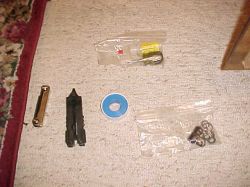
NO matter what happens you will definitely break parts in the field and you will need certain tools to repair your gun. A good repair kit is pictured below and it includes, an allen wrench set, a gerber multi tool (needle nose), spare o-rings (as many as possible), paintball gun oil (ask your dealer for some tubes and NEVER use household oil or grease in a paintball gun), spare springs, a spare parts kit for YOUR gun, thread sealer, and anything else you might need in the field.
Part 2: The Gun
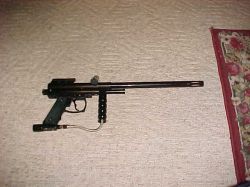
OK OK OK , now that you are finally outfitted with the proper gear we can move on to everyones favorite part, THE GUN. Now there are many guns on the market, semi auto, auto, pump, pistol, etc. etc. the list goes on and on. However, if you are a beginning or amateur player I would recommend NOT going out and buying a 1000 dollar angel or auto cocker. Yes these are top of the line but there are techniques to using these markers and its best to start out with a cheaper gun and work your way up. I prefer to use the Spyder line of paintball guns. They are all semi automatic, sturdy, and cheap. A good combo for any person interested in just starting out. I recently decided to switch to a spyder shutter but at this time I am still using my spyder compact 2000 so for all purposes I will use this as my example. OK the basic parts of the gun include the trigger, grip, barrel, body, feed chamber, bolt, velocity adjuster, low pressurr chamber, bottom line, and sight rail.
The Bolt
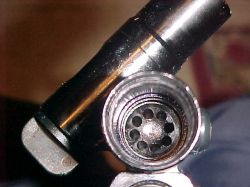
The bolt is the single most important part of any paintball marker. It forces air onto the ball and sends it down the barrel. Many bolts are just an open tube which can cause uneven distribution of the air and break balls as well as affect accuracy. The new "Venturi" style bolt (pictured below inside the chamber) has 10 smaller holes which evenly distributes the air and allows for increased accuracy and range.
The Barrel
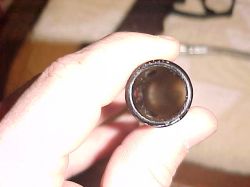
The next most important part of a paintball gun is a barrel. This is what determines wether the gun will travel down range straight or curve off. Most barrels are between 12-16 inches and are very LOUD because they allow the excess CO2 to escape out the end of the barrel. However, newer barrels are ported (have small holes down the barrel) and are much quieter as well as have muzzle brakes, rifled tubes, and are up to 20 inches long. The longer the barrel the more accurate and will allow the ball to travel farther. I opt to use a 20 inch Stone Cold 2 barrel which will reach out and touch anyone. The Barrel pictured below is a 14 inch War Pig barrel.
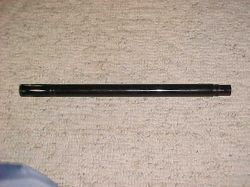
The Feeder Tube
The Feed tube feeds paintballs from the hopper to the chamber. It has a knob which will allow you to block the paintballs from coming in the chamber. It is imperative to keep this chamber clear.
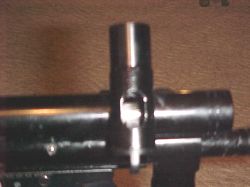
Low Pressure Chamber and Bottom Line Kit (Pictured below)
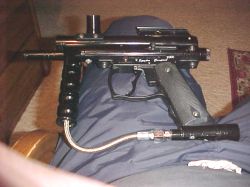
The Bottom line kit allows the spyder compact to mount the tank at the back of the gun and use the tank as a stock and the low pressure chamber lowers the pressure of the gun which will result in less ball breaks. Most guns need to maintain a pressure of 200 PSI to fire effectively. Without a low pressure chamber the PSI can go as high as 900 and will break almost any ball. You can also see the tube which helps maintain the CO2 in a gaseous form. If the CO2 becomes too cold it will transform into a liquid and freeze the internal parts.
Velocity Adjuster
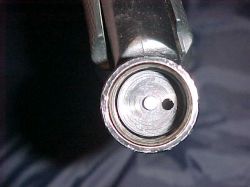
The velocity adjuster is located at the rear of the gun body and allows the user to adjust the velocity of the gun. Most guns velocity and be adjusted via an allen wrench but for tournament play a thumb adjustable dial (pictured below) has been invented. It allows you to make on the fly adjustments and then lock them in place. Most field require that your gun shoot UNDER 300 F.P.S. and this is the way to lower the gun. Anything faster than 300 F.P.S. can shatter masks and injure people
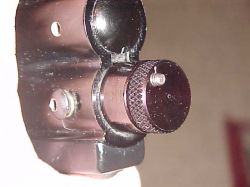
Sight Rail
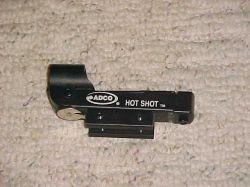
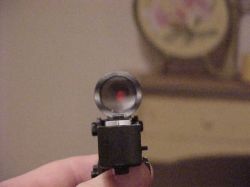
The sight rail of the gun is located behind the feeder tube and will allow you to aim down the barrel of the gun. This is useful for short (less than 15 yard but for longer shots an ACOG replica or similar would be suitable. I use an ADCO ACOG replica which helps me put shots up to 50 yards with my barrel. It superimposes a red dot on the target without actually projecting it.
Stay tuned for more articles on paintball. If you have any questions e-mail me at the address below my name. HAPPY SHOOTING and remember: Some of the second best players in the world are wearing MY PAINT.
All materials at this site not otherwise credited are Copyright © 1996 - 2002 Trip Williams. All rights reserved. May be reproduced for personal use only. Use of any material contained herein is subject to stated terms or written permission.